
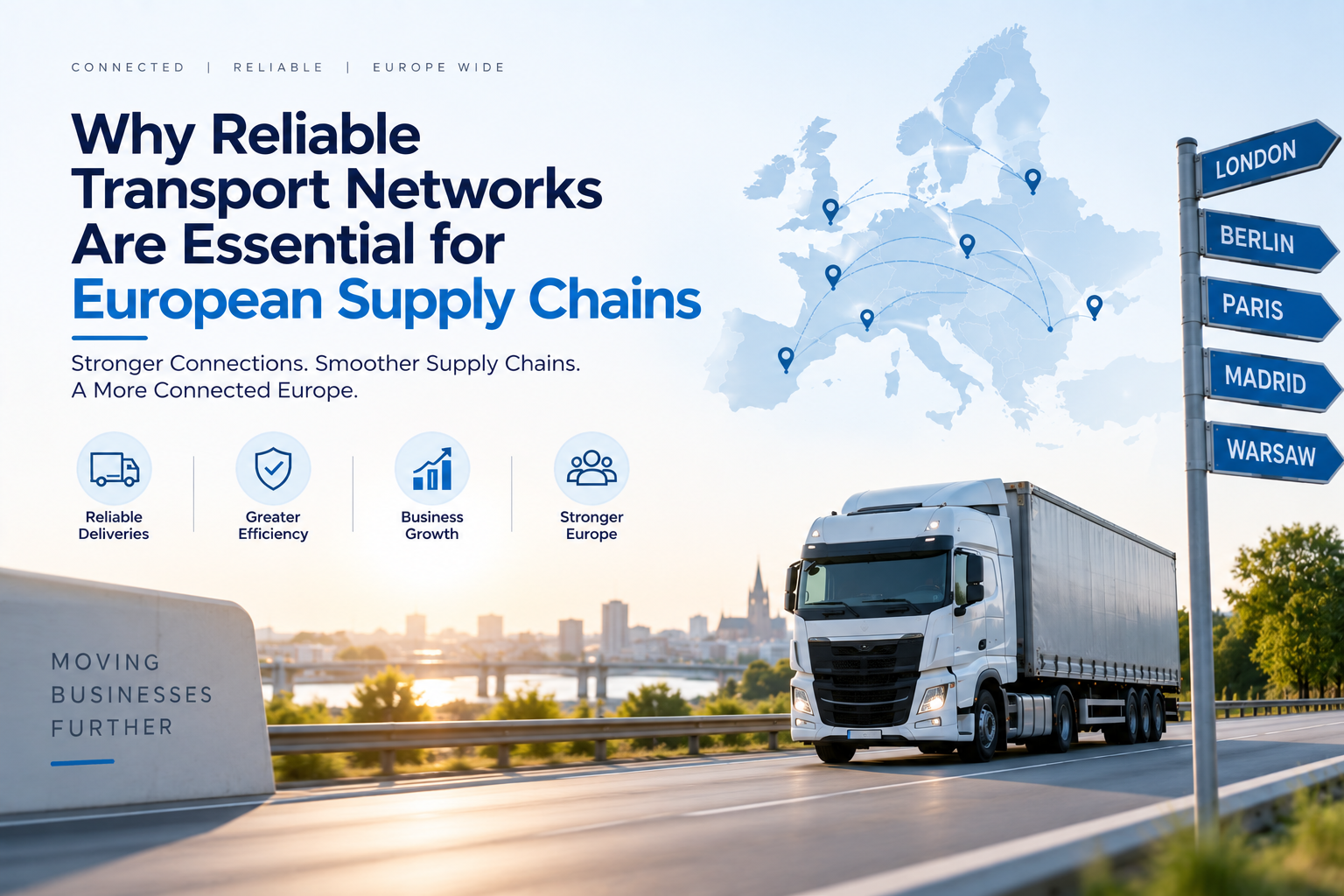
Modern businesses depend on transportation networks to keep goods moving.
Raw materials need to reach manufacturers. Finished products need to move to warehouses. Retailers need regular deliveries. Customers expect orders to arrive when promised.
Across Europe, these activities create complex supply chains connecting businesses, suppliers, distribution centres and customers across multiple markets.
At the centre of these supply chains are reliable transport networks.
A dependable transportation network helps businesses move goods efficiently, maintain inventory levels, meet customer expectations and respond to changing market conditions.
For companies operating across Europe, transportation is not simply a way to move products.
It is a fundamental part of business continuity and growth.
What Is a Transport Network?
A transport network is the combination of routes, vehicles, carriers, infrastructure and logistics operations used to move goods between different locations.
A European freight network may connect:
Suppliers → Manufacturers → Warehouses → Distribution Centres → Businesses → Customers
Transportation can involve different modes depending on the shipment and destination, including:
- Road freight
- Rail freight
- Sea freight
- Air freight
- Multimodal transportation
The effectiveness of this network can have a direct impact on the performance of the wider supply chain.
Why Are Reliable Transport Networks Important?
A supply chain can only perform as well as its weakest connections.
If transportation is unreliable, businesses may experience:
- Delayed deliveries
- Inventory shortages
- Production interruptions
- Increased logistics costs
- Customer dissatisfaction
- Poor supply chain visibility
Reliable transportation helps businesses create greater predictability throughout their operations.
1. Reliable Transportation Keeps Goods Moving
The most basic role of a transport network is to keep goods moving from one location to another.
Businesses depend on regular freight movement to maintain production and distribution schedules.
A reliable transportation network helps ensure that shipments are collected, transported and delivered according to planned schedules.
This consistency allows businesses to coordinate other parts of their supply chain more effectively.
2. Transport Networks Support European Market Expansion
Europe provides businesses with access to a large and interconnected market.
As companies expand into new countries, their transportation requirements also increase.
A business may need to move goods between:
- Suppliers and European warehouses
- Distribution centres and retailers
- Manufacturing facilities and customers
- Multiple European markets
A strong European transport network can make this expansion easier to manage.
Instead of treating every new destination as an entirely separate logistics operation, businesses can build a coordinated transportation strategy.
3. Reliable Freight Reduces Supply Chain Disruptions
Supply chains are vulnerable to disruptions.
Traffic, weather, infrastructure issues, capacity shortages and other unexpected events can affect freight transportation.
A reliable transport network can help businesses respond more effectively.
Alternative routes, transportation options and contingency planning can provide additional flexibility when normal operations are disrupted.
The goal is not to eliminate every possible disruption.
It is to make the supply chain better prepared to handle change.
4. Transportation Reliability Improves Inventory Planning
Inventory and transportation are closely connected.
Businesses need incoming goods to arrive when expected so they can maintain appropriate stock levels.
If transportation becomes unpredictable, companies may need to hold additional inventory as a precaution.
This can increase storage costs and tie up capital.
More reliable freight transportation can help businesses plan inventory with greater confidence.
When companies have a clearer understanding of transportation schedules, they can make better decisions about stock levels and replenishment.
5. Reliable Transport Helps Control Logistics Costs
Transportation is a major component of supply chain costs.
Inefficient logistics can create additional expenses through:
- Unnecessary mileage
- Emergency shipments
- Additional handling
- Vehicle downtime
- Failed deliveries
- Poor route planning
A reliable transport network focuses on efficient planning and consistent execution.
Better coordination can help businesses make more effective use of transportation capacity and reduce avoidable costs.
6. Transport Networks Improve Customer Service
Customers expect businesses to deliver products reliably.
Whether the customer is another business or an individual consumer, transportation performance can influence their experience.
A dependable freight network can support:
- More predictable delivery times
- Better shipment communication
- Fewer delivery problems
- Improved order fulfilment
- Greater customer confidence
For businesses competing on service quality, logistics reliability can become an important competitive advantage.
7. European Supply Chains Need Cross-Border Connectivity
European supply chains often cross national borders.
A product may be manufactured in one country, stored in another and delivered to customers in several additional markets.
This requires coordinated transportation across different routes and locations.
Cross-border logistics therefore plays an important role in European supply chain management.
Businesses need logistics partners that understand international freight requirements and can coordinate transportation across relevant European routes.
8. Better Transport Networks Improve Supply Chain Visibility
Modern businesses need to know what is happening to their shipments.
Shipment tracking and digital logistics systems can provide greater visibility into freight movements.
Businesses may be able to monitor:
- Shipment location
- Transportation progress
- Estimated arrival
- Delivery status
- Potential delays
Better visibility allows logistics teams to respond more quickly when something changes.
It also helps businesses provide more accurate information to customers.
9. Reliable Transportation Supports Just-in-Time Operations
Some businesses operate with tightly coordinated inventory and production schedules.
For these companies, transportation reliability is particularly important.
If a critical shipment arrives late, production or distribution activities may be affected.
Reliable transport networks help businesses coordinate deliveries more closely with operational requirements.
This can reduce unnecessary inventory while maintaining supply continuity.
10. Flexible Transport Networks Help Businesses Adapt
Reliability does not mean that a transportation network must always operate in exactly the same way.
In fact, flexibility is an important part of reliability.
Businesses may need to change:
- Routes
- Delivery schedules
- Transportation modes
- Shipment volumes
- Distribution locations
A flexible logistics network can adapt to these changes without major disruption.
This is especially valuable for growing businesses and companies expanding into new European markets.
11. Technology Is Strengthening European Freight Networks
Technology is transforming freight transportation.
Modern logistics systems can support:
- Real-time shipment tracking
- Route optimisation
- Fleet management
- Digital documentation
- Transportation scheduling
- Data analysis
- Automated notifications
These tools can help logistics providers and businesses make better decisions.
Technology can also improve communication between different participants in the supply chain.
12. Data Helps Identify Transportation Problems
Reliable transport networks are not built only through vehicles and routes.
They also depend on information.
Businesses can analyse transportation data to identify:
- Recurring delays
- Inefficient routes
- Delivery performance
- Capacity problems
- Cost trends
This information can help logistics teams make improvements over time.
Instead of simply reacting to transportation problems, businesses can use historical data to understand why problems occur.
13. Reliable Transport Supports Business Continuity
Business continuity depends on the continued movement of essential goods.
If transportation stops, other parts of the supply chain can quickly be affected.
A strong transport network provides businesses with greater resilience.
Contingency planning can include:
- Alternative routes
- Multiple transportation providers
- Backup capacity
- Flexible delivery schedules
- Alternative distribution locations
These options can help businesses continue operating when unexpected conditions affect normal transportation.
14. Sustainable Transport Networks Can Improve Efficiency
Transportation efficiency and sustainability can work together.
Better route planning, improved vehicle utilisation and appropriate use of multimodal transportation can help businesses avoid unnecessary freight movements.
Businesses can consider factors such as:
- Route efficiency
- Vehicle utilisation
- Transportation mode
- Shipment consolidation
- Delivery planning
More efficient transportation can potentially reduce resource consumption while also improving operational performance.
15. Reliable Transport Networks Help Businesses Scale
Growth creates greater transportation requirements.
A company that initially manages a small number of shipments may eventually need to handle significantly higher volumes across multiple countries.
A scalable transport network allows businesses to increase their logistics capacity as demand grows.
This can support a progression such as:
Local Growth → Regional Expansion → European Expansion → Wider International Operations
The right logistics partner can help businesses scale transportation without having to rebuild their entire supply chain.
Common Challenges Facing European Transport Networks
Businesses operating across Europe may face several transportation challenges.
Traffic and Congestion
Busy roads and urban areas can affect delivery schedules.
Capacity Constraints
Transportation availability can change depending on market demand.
Border and Customs Processes
International shipments may require additional documentation and procedures.
Weather
Severe weather can affect roads, ports and other transportation infrastructure.
Changing Customer Expectations
Customers increasingly expect reliable and transparent delivery services.
Rising Supply Chain Complexity
As businesses operate across more locations, coordinating transportation becomes more difficult.
A well-managed logistics strategy can help businesses prepare for these challenges.
How Businesses Can Build a More Reliable Transport Strategy
Businesses can improve transportation reliability by taking a structured approach.
Understand Your Transportation Requirements
Identify your regular routes, shipment volumes and delivery requirements.
Work With Reliable Logistics Providers
Choose partners with the capacity and experience to support your operations.
Use Shipment Tracking
Improve visibility into freight movements and delivery schedules.
Build Contingency Plans
Identify alternative routes, carriers and transportation options.
Measure Performance
Track delivery reliability, transit times and transportation costs.
Review the Network Regularly
As your business grows, your logistics network should evolve with it.
Choosing a Reliable European Logistics Partner
The logistics provider you choose can have a significant impact on transportation performance.
Before selecting a partner, businesses should evaluate:
Geographic Coverage
Can the provider support your current and future European destinations?
Transportation Capabilities
Can they provide the freight services your business requires?
Reliability
Do they have processes for maintaining consistent delivery performance?
Communication
Can you quickly receive information about your shipments?
Technology
Do they offer tracking and useful logistics visibility?
Flexibility
Can they adapt when shipment volumes or routes change?
Scalability
Can they support your business as it grows?
A strong logistics partnership should be built around long-term operational needs rather than a single shipment.
Reliable European Logistics With Immensity Global
For businesses operating across Europe, reliable transportation is essential to maintaining an efficient supply chain.
At Immensity Global, we understand that freight transportation involves more than moving goods from one location to another.
It requires careful planning, coordination, communication and the ability to respond when conditions change.
Our focus is on providing dependable logistics and transportation solutions that can support modern businesses and their changing requirements.
Whether your company needs regular freight transportation, cross-border logistics or scalable logistics support, a reliable transportation strategy can help create a stronger supply chain.
Reliable transport. Better coordination. Stronger supply chains.
If your business is looking for dependable European freight transportation and logistics support, contact Immensity Global to discuss your requirements.
Frequently Asked Questions
Why are transport networks important for supply chains?
Transport networks connect suppliers, manufacturers, warehouses, businesses and customers. Reliable transportation helps goods move efficiently and supports consistent supply chain operations.
What makes a transport network reliable?
Reliability depends on factors such as transportation capacity, route planning, communication, shipment visibility, operational experience and the ability to respond to disruptions.
How do transport networks support European businesses?
They allow businesses to move goods between European markets, suppliers, warehouses, distribution centres and customers.
Can reliable transportation reduce logistics costs?
Efficient transportation planning can help reduce unnecessary mileage, emergency shipments, delays, vehicle downtime and other avoidable costs.
Why is cross-border transportation important in Europe?
Many European supply chains operate across national borders. Cross-border transportation helps businesses connect suppliers, facilities and customers across different markets.
How does technology improve transportation reliability?
Tracking, route optimisation, digital communication and data analysis can improve shipment visibility and help businesses respond to transportation issues.
How can businesses prepare for transport disruptions?
Businesses can develop contingency plans involving alternative routes, carriers, transportation modes and delivery arrangements.
Should businesses choose a scalable logistics partner?
Yes. A scalable provider can adjust transportation capacity as shipment volumes, destinations and business requirements change.
Final Thoughts
Reliable transport networks are the backbone of modern European supply chains.
They connect businesses with suppliers and customers, support inventory planning, improve delivery performance and help companies respond to changing market conditions.
For businesses operating across Europe, transportation should be viewed as a strategic part of the supply chain rather than simply an operational expense.
The strongest logistics networks combine reliability, flexibility, visibility and scalability.
When these elements work together, businesses can move goods with greater confidence and build supply chains capable of supporting long-term growth.
Reliable transport keeps supply chains moving — and strong supply chains keep businesses growing.