
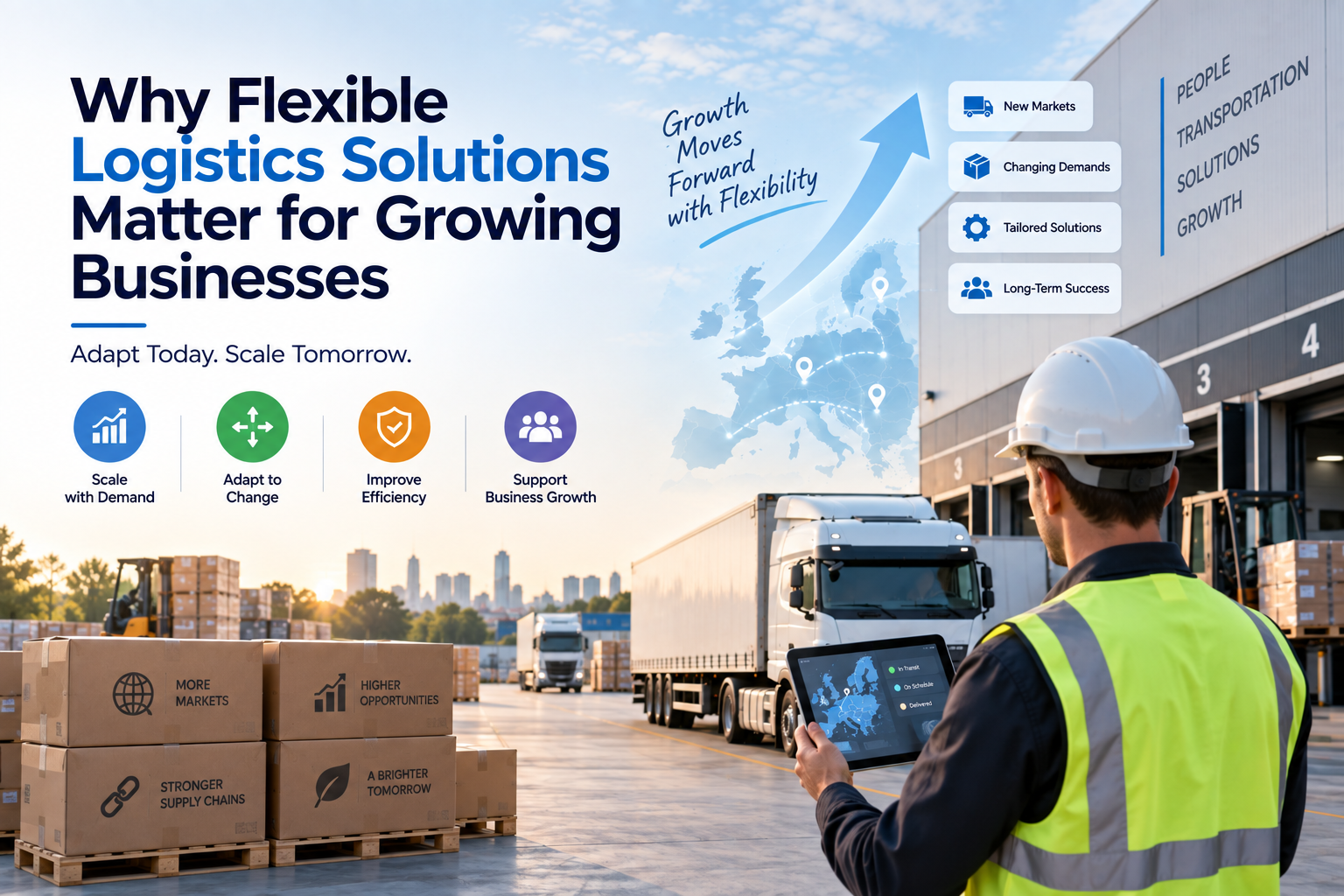
Growth is one of the most exciting stages for any business.
More customers, higher order volumes and expansion into new markets can create significant opportunities. But growth also brings new operational challenges — especially when it comes to logistics.
A transportation system that works well for a small business may not be suitable once shipment volumes increase.
New destinations, changing customer expectations, seasonal demand and tighter delivery schedules can all put pressure on an existing supply chain.
This is why flexible logistics solutions are becoming increasingly important for growing businesses.
Instead of relying on a fixed logistics model, companies can work with adaptable transportation and supply chain solutions that change as their business requirements change.
What Are Flexible Logistics Solutions?
Flexible logistics solutions are transportation and supply chain services that can adapt to changing business requirements.
Flexibility may involve:
- Adjusting transportation capacity
- Supporting changing shipment volumes
- Adding new delivery destinations
- Handling seasonal demand
- Offering different transportation options
- Responding to urgent requirements
- Supporting business expansion
- Adjusting delivery schedules
The purpose is simple: your logistics operation should be able to grow and change with your business.
Why Do Growing Businesses Need Flexible Logistics?
Business growth rarely happens in a perfectly predictable way.
A company might experience a sudden increase in orders after a successful marketing campaign. A new customer could require regular deliveries to a different region. Seasonal demand could temporarily increase shipment volumes.
If logistics cannot adapt, growth can quickly become difficult to manage.
Flexible logistics allows businesses to respond to changing circumstances without completely rebuilding their transportation network.
1. Flexible Logistics Supports Business Growth
As businesses grow, their logistics requirements usually grow with them.
A company may move from:
Local deliveries → Regional distribution → National transportation → European expansion
Each stage can require additional transportation capacity and more sophisticated logistics coordination.
A flexible logistics partner can help businesses adjust their operations as they move through these stages.
Instead of constantly searching for a new logistics provider, businesses can build a relationship with a partner capable of supporting their changing requirements.
2. Shipment Volumes Can Change Quickly
One of the biggest challenges for growing businesses is unpredictable demand.
A business may have relatively stable shipment volumes for several months and then experience a significant increase.
Flexible logistics allows transportation capacity to be adjusted when required.
This can be especially useful during:
- Seasonal peaks
- Product launches
- Promotional campaigns
- New customer contracts
- Market expansion
- Unexpected increases in demand
The ability to scale transportation capacity can help businesses avoid unnecessary disruption.
3. Flexible Transportation Helps Control Costs
Businesses do not always need the same transportation solution for every shipment.
Shipment size, destination, urgency and delivery requirements can all vary.
A flexible logistics strategy allows businesses to select transportation solutions according to their specific needs.
For example, a business may require:
- Standard freight for regular shipments
- Dedicated transportation for specific customers
- Faster transportation for urgent orders
- Different routes for new destinations
This approach can help businesses avoid paying for unnecessary transportation capacity while maintaining reliable service.
4. Flexible Logistics Helps Businesses Enter New Markets
Expansion into a new market can create additional logistics challenges.
A business may need to serve customers in a new city, region or country.
Instead of building an entirely new logistics operation, companies can work with logistics partners that already have suitable transportation capabilities and network coverage.
This can make expansion easier to manage.
For businesses entering European markets, flexible cross-border logistics can be particularly valuable as the number of destinations increases.
5. It Helps Businesses Respond to Customer Expectations
Customer expectations continue to evolve.
Customers may expect faster deliveries, better shipment visibility and more flexible delivery options.
Businesses need logistics systems capable of adapting to these expectations.
Flexible logistics can help companies respond to changing requirements without making major changes to their entire supply chain.
A responsive transportation operation can become an important part of maintaining customer satisfaction.
6. Flexible Logistics Improves Supply Chain Resilience
Unexpected problems are a reality of transportation.
Road closures, weather conditions, capacity shortages and operational disruptions can affect freight movement.
A rigid logistics network may struggle when something changes.
A flexible network can provide more options.
Businesses may be able to:
- Adjust transportation routes
- Use alternative carriers
- Change delivery schedules
- Reallocate transportation capacity
- Prioritise urgent shipments
This flexibility can make supply chains more resilient when unexpected events occur.
7. Seasonal Businesses Benefit From Flexible Capacity
Some businesses experience significant changes in demand throughout the year.
For example, retail, e-commerce and certain manufacturing businesses may experience major seasonal peaks.
Maintaining maximum transportation capacity throughout the entire year may not be cost-effective.
Flexible logistics allows businesses to increase transportation support during high-demand periods and return to normal capacity when demand decreases.
This creates a more adaptable logistics model.
8. Flexibility Supports Faster Decision-Making
Growing businesses often need to make decisions quickly.
A new order may require urgent transportation. A customer may change a delivery requirement. A new market opportunity may require additional freight capacity.
Businesses with flexible logistics arrangements can respond more quickly.
Instead of spending significant time negotiating new transportation arrangements, they can work with an established logistics partner that understands their operations.
This can save valuable time.
9. Technology Makes Flexible Logistics Easier
Modern logistics technology is making transportation more adaptable.
Digital tools can support:
- Shipment tracking
- Route optimisation
- Transportation planning
- Delivery scheduling
- Capacity management
- Data analysis
- Communication
Better visibility allows businesses and logistics providers to make faster decisions when requirements change.
Technology can therefore help create logistics operations that are both flexible and efficient.
10. Flexible Logistics Can Improve Customer Service
When logistics operations can adapt, businesses can provide more consistent service.
If shipment volumes increase, transportation capacity can be adjusted.
If a customer requires a different delivery schedule, logistics arrangements can be modified.
If a shipment is delayed, alternative options may be considered.
This flexibility helps businesses respond to customer requirements rather than forcing customers to work around a rigid logistics system.
11. Flexibility Is Important for International Logistics
International logistics can involve additional complexity.
Businesses may need to coordinate transportation across multiple countries, routes and distribution points.
As international operations grow, logistics requirements can change quickly.
A flexible logistics provider can help businesses adjust transportation arrangements as their international network develops.
This is particularly important for companies expanding across Europe.
12. Flexible Logistics Supports E-Commerce Growth
E-commerce businesses can experience rapid changes in order volumes.
A successful promotion, product launch or seasonal event can significantly increase demand.
This makes logistics flexibility essential.
E-commerce companies may need to manage:
- Higher shipment volumes
- Faster delivery expectations
- Multiple delivery destinations
- Returns
- Seasonal peaks
- Changing customer expectations
A scalable logistics solution can help businesses manage this changing environment more effectively.
13. Flexible Logistics Helps Businesses Scale Without Overbuilding
One common challenge for growing businesses is deciding how much logistics infrastructure they actually need.
Building a large internal logistics operation too early can create unnecessary costs.
At the same time, insufficient capacity can limit growth.
Working with a flexible logistics provider can help businesses access transportation resources as needed.
This can allow companies to scale their logistics operations gradually alongside their actual demand.
What Should Businesses Look for in a Flexible Logistics Partner?
Not every logistics provider offers the same level of flexibility.
When choosing a partner, businesses should consider several factors.
Transportation Capacity
Can the provider handle increases in shipment volume?
Geographic Coverage
Can they support new destinations as the business expands?
Range of Services
Can they provide different transportation solutions when requirements change?
Communication
Can they respond quickly when schedules or requirements change?
Technology
Do they provide tracking and visibility?
Scalability
Can their services grow alongside the business?
Problem-Solving
How do they respond when unexpected transportation challenges occur?
A logistics provider should be able to answer these questions clearly.
How to Build a More Flexible Logistics Strategy
Businesses can take several practical steps to improve logistics flexibility.
Understand Your Shipment Patterns
Analyse current shipment volumes, destinations and delivery requirements.
Identify Potential Growth Areas
Consider where your business is likely to expand and how that could affect transportation.
Build Strong Logistics Relationships
A reliable logistics partner can make it easier to adapt when requirements change.
Use Technology
Tracking, planning and data tools can improve visibility and decision-making.
Plan for Peak Demand
Identify periods when shipment volumes may increase and plan transportation capacity in advance.
Review Your Logistics Strategy Regularly
Your logistics requirements should evolve as your business evolves.
Flexible Logistics vs. Fixed Logistics
A fixed logistics model is designed around relatively stable requirements.
A flexible logistics model is designed around change.
| Fixed LogisticsFlexible Logistics | |
|---|---|
| Stable capacity | Adjustable capacity |
| Limited options | Multiple transportation options |
| Fixed routes | Adaptable routes |
| Less responsive | More responsive |
| Designed for current needs | Designed for current and future needs |
| Harder to scale | Easier to scale |
For businesses experiencing growth or market changes, flexibility can provide a significant operational advantage.
Why Immensity Global Supports Flexible Logistics
Growing businesses need logistics partners that understand that requirements can change.
At Immensity Global, we focus on providing reliable transportation and logistics solutions that can adapt to different business requirements.
Every business has different shipment volumes, destinations, schedules and operational priorities.
That is why logistics should not be treated as a one-size-fits-all service.
A flexible approach can help businesses:
- Manage changing shipment volumes
- Support new destinations
- Improve transportation efficiency
- Respond to customer requirements
- Scale logistics operations
- Manage cross-border freight
Our goal is to help businesses create logistics operations that support growth rather than limit it.
Flexible logistics. Reliable transportation. Built for business growth.
If your business is growing and your logistics requirements are changing, contact Immensity Global to discuss your transportation needs.
Frequently Asked Questions
What are flexible logistics solutions?
Flexible logistics solutions are transportation and supply chain services that can adapt to changing shipment volumes, destinations, schedules and business requirements.
Why is flexibility important in logistics?
Business requirements can change quickly. Flexible logistics allows companies to adjust transportation capacity and processes as demand and operational needs change.
Can flexible logistics help growing businesses?
Yes. Flexible logistics can help businesses scale transportation capacity, enter new markets and respond to increasing shipment volumes.
How does flexible logistics reduce costs?
Businesses can adjust transportation resources according to demand rather than maintaining unnecessary capacity throughout the year.
Is flexible logistics useful for international businesses?
Yes. Businesses operating across multiple countries can benefit from adaptable transportation networks and logistics solutions.
How does technology support flexible logistics?
Technology can provide shipment visibility, route planning, transportation scheduling and data that helps businesses respond to changing requirements.
What should I consider when choosing a flexible logistics provider?
Consider transportation capacity, geographic coverage, technology, communication, service flexibility, scalability and experience.
Final Thoughts
Growth creates opportunities, but it also creates complexity.
As shipment volumes increase and businesses expand into new markets, logistics operations need to become more adaptable.
Flexible logistics solutions give businesses the ability to respond to changing demand, manage new destinations, improve customer service and scale transportation capacity when needed.
The strongest logistics strategy is not necessarily the one designed for today’s requirements.
It is the one that can adapt to tomorrow’s opportunities.
For growing businesses, flexibility is more than a logistics benefit.
It is a foundation for sustainable growth.