
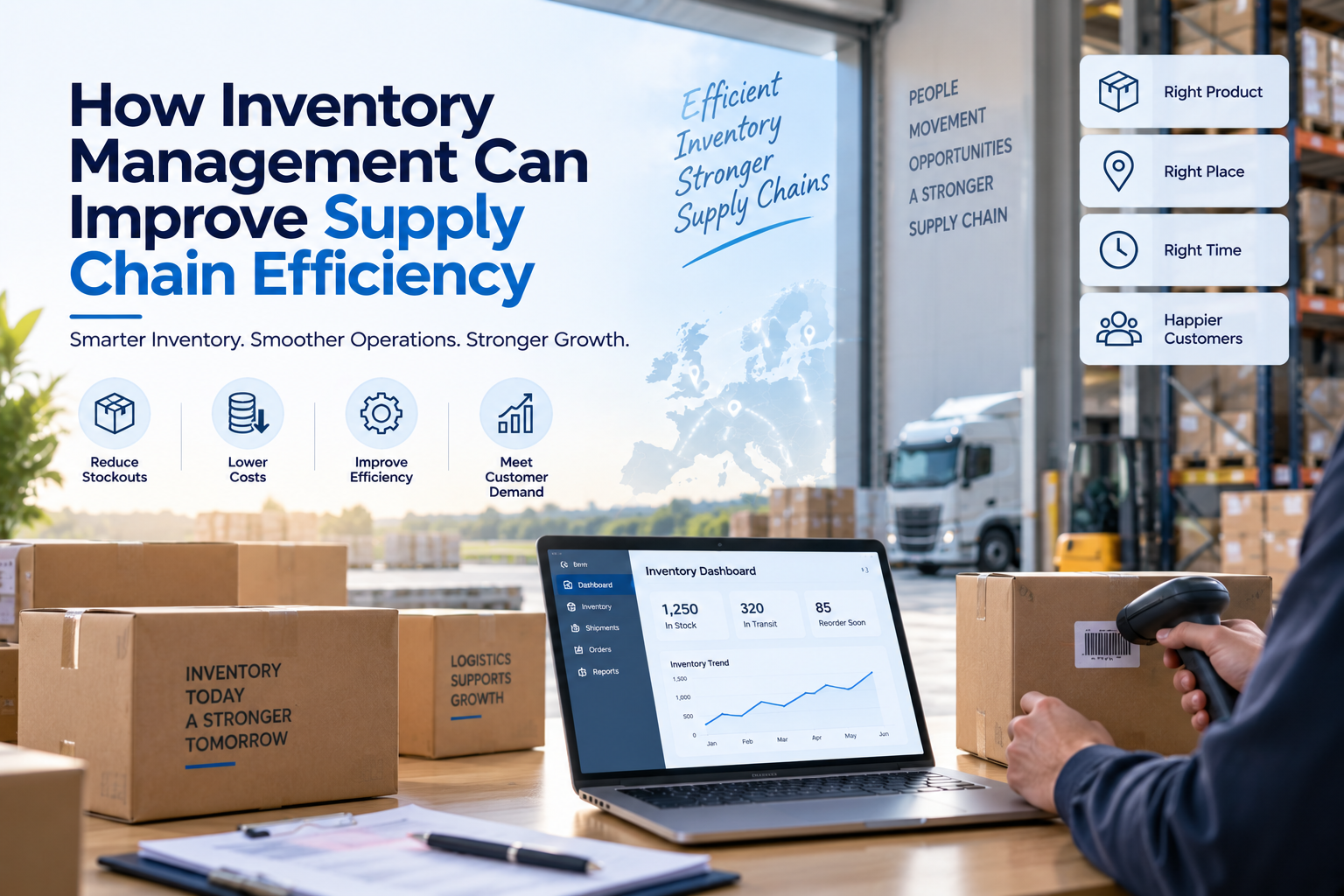
A successful supply chain depends on having the right products, in the right place, at the right time.
When inventory is poorly managed, businesses can face unnecessary storage costs, stock shortages, excess inventory, delayed orders and transportation problems.
Effective inventory management helps businesses maintain better control over their products while coordinating purchasing, warehousing, transportation and customer demand.
For modern businesses, inventory management is no longer simply about counting products.
It is about creating a supply chain that operates efficiently from the moment goods enter the business until they reach the customer.
What Is Inventory Management?
Inventory management is the process of ordering, storing, monitoring and controlling the goods a business keeps available for production, distribution or sale.
It can involve:
- Tracking inventory levels
- Managing stock movement
- Planning purchases
- Organising warehouse storage
- Monitoring demand
- Managing incoming shipments
- Preventing stock shortages
- Reducing excess inventory
- Coordinating distribution
The objective is to maintain enough inventory to meet business requirements without holding unnecessary stock.
Why Is Inventory Management Important?
Inventory represents a significant operational investment for many businesses.
Too much inventory can tie up capital and increase storage requirements.
Too little inventory can result in stock shortages, delayed orders and dissatisfied customers.
Effective inventory management helps businesses find a better balance.
A well-managed inventory system can contribute to:
- Lower storage costs
- Better warehouse organisation
- Improved order fulfilment
- Fewer stock shortages
- Better transportation planning
- More accurate forecasting
- Improved customer service
Inventory management therefore has a direct connection to supply chain efficiency.
1. Inventory Management Improves Stock Visibility
Businesses need to know what inventory they have and where it is located.
Without accurate visibility, companies may not know when products need to be reordered or where specific items are stored.
Inventory management systems can help businesses track:
- Available stock
- Incoming inventory
- Outgoing products
- Stock locations
- Reorder requirements
- Inventory movement
Better visibility allows businesses to make more informed supply chain decisions.
2. It Helps Prevent Stockouts
A stockout occurs when a business does not have enough inventory to fulfil demand.
This can create several problems.
Customers may have to wait longer for their orders, sales opportunities can be lost and emergency transportation may become necessary.
Effective inventory management helps businesses monitor stock levels and identify when replenishment may be required.
By planning inventory more effectively, businesses can reduce the risk of unexpected shortages.
3. It Reduces Excess Inventory
Having too much inventory can also create problems.
Excess stock may require additional warehouse space and increase storage and handling costs.
For products with limited shelf life or changing market demand, excess inventory can also create the risk of waste or obsolescence.
Better inventory planning helps businesses maintain stock levels that are more closely aligned with actual demand.
The goal is not to hold as much inventory as possible.
The goal is to hold the right amount of inventory.
4. Better Inventory Management Improves Warehouse Efficiency
Inventory and warehousing are closely connected.
When products are organised efficiently, warehouse teams can find, move and prepare goods more quickly.
Good inventory management can support:
- Better storage organisation
- Faster picking
- More efficient packing
- Improved stock rotation
- Reduced unnecessary handling
- Better use of warehouse space
A more organised warehouse can contribute to faster and more reliable order fulfilment.
5. It Supports Better Demand Planning
Customer demand can change.
Businesses may experience seasonal peaks, market fluctuations or unexpected increases in orders.
Inventory management helps companies analyse previous demand and current stock levels when planning future requirements.
Better demand planning can help businesses determine:
- What products need to be ordered
- When replenishment should occur
- How much stock should be maintained
- Which products are moving quickly
- Which products are moving slowly
This can create a more responsive supply chain.
6. Inventory Management Improves Order Fulfilment
Customers expect businesses to fulfil orders accurately and on time.
Poor inventory records can make this difficult.
If the system shows that a product is available when it is actually out of stock, an order may be delayed.
Accurate inventory information helps businesses understand what is available and fulfil orders more efficiently.
This can improve the customer experience while reducing avoidable operational problems.
7. Better Inventory Control Supports Transportation Planning
Inventory management does not stop at the warehouse.
It also affects transportation.
Businesses need to coordinate incoming shipments, transfers between facilities and outgoing deliveries.
Accurate inventory information can help logistics teams understand:
- When goods need to arrive
- Where inventory needs to go
- Which shipments should be prioritised
- How much transportation capacity may be required
Better coordination between inventory and transportation can help reduce unnecessary freight movements.
8. It Can Reduce Logistics Costs
Poor inventory management can create additional logistics expenses.
For example, businesses may need urgent shipments because inventory was not replenished on time.
They may also move products unnecessarily between warehouses because stock information was inaccurate.
Better inventory planning can help reduce these situations.
By coordinating inventory levels, warehouse operations and transportation schedules, businesses can create a more efficient logistics process.
9. Inventory Management Improves Supply Chain Coordination
A supply chain can involve many different participants.
Suppliers, manufacturers, warehouses, logistics providers, distributors and customers all depend on accurate information.
Inventory management provides an important connection between these activities.
For example:
Supplier → Incoming Freight → Warehouse → Distribution → Customer
When inventory information is accurate, each stage can be planned more effectively.
10. It Improves Supplier Management
Inventory management can also help businesses work more effectively with suppliers.
By analysing purchasing and inventory data, companies can identify:
- Typical order quantities
- Replenishment patterns
- Supplier lead times
- Product demand
- Potential supply issues
This information can support better purchasing decisions and supplier communication.
Businesses can also identify products that may require longer lead times and plan accordingly.
11. Better Inventory Data Supports Business Decisions
Inventory data can provide valuable information about business performance.
Businesses can analyse which products sell quickly, which products remain in storage longer and which items require frequent replenishment.
This can support decisions around:
- Purchasing
- Pricing
- Warehousing
- Product selection
- Distribution
- Transportation
Better information can lead to better decisions throughout the organisation.
12. Technology Is Transforming Inventory Management
Modern inventory management increasingly relies on digital technology.
Businesses can use software and connected systems to monitor inventory and coordinate supply chain activities.
Technology can support:
- Digital stock records
- Barcode scanning
- Warehouse management
- Automated alerts
- Demand forecasting
- Shipment tracking
- Inventory reporting
- Data analysis
These tools can reduce reliance on manual processes and provide businesses with more accurate information.
13. Real-Time Information Improves Supply Chain Visibility
Real-time information can make inventory management more responsive.
When businesses can see current inventory levels and incoming shipments, they can make decisions faster.
For example, if an incoming shipment is delayed, logistics teams can identify the potential impact and consider alternative arrangements.
This is particularly important for businesses with complex or international supply chains.
14. Inventory Management Can Improve Customer Satisfaction
Customers may never see a company’s inventory system, but they experience its results.
Good inventory management can help businesses provide:
- Better product availability
- More accurate delivery expectations
- Faster order fulfilment
- Fewer order cancellations
- More reliable service
When products are available when customers need them, the overall customer experience improves.
15. Efficient Inventory Management Supports Business Growth
As businesses grow, inventory requirements can become more complex.
A company may add:
- New products
- New warehouses
- New suppliers
- New customers
- New markets
- Higher order volumes
A scalable inventory management strategy can help businesses manage this growth.
Without effective systems, increasing inventory volumes can quickly create operational complexity.
Common Inventory Management Problems
Businesses should be aware of several common inventory challenges.
Overstocking
Holding more inventory than necessary can increase storage costs and tie up working capital.
Understocking
Insufficient inventory can result in missed sales and customer delays.
Inaccurate Inventory Records
Incorrect stock information can create problems throughout the supply chain.
Poor Warehouse Organisation
Disorganised storage can increase handling time and reduce efficiency.
Limited Visibility
Without accurate information, businesses may struggle to make timely supply chain decisions.
Poor Demand Forecasting
Unexpected changes in demand can result in either shortages or excess inventory.
How Businesses Can Improve Inventory Management
Improving inventory management does not necessarily require a complete operational overhaul.
Businesses can start with several practical steps.
1. Track Inventory Accurately
Maintain reliable information about stock levels and locations.
2. Monitor Demand
Analyse sales patterns and identify seasonal or changing demand.
3. Establish Reorder Points
Determine when products should be replenished.
4. Organise Warehouse Operations
Create logical storage and handling processes.
5. Monitor Slow-Moving Inventory
Identify products that remain in storage for extended periods.
6. Coordinate With Logistics Providers
Make sure transportation schedules support inventory requirements.
7. Use Technology
Digital inventory and logistics systems can improve visibility and reduce manual work.
The Connection Between Inventory and Logistics
Inventory management and logistics should not be treated as completely separate functions.
They work together.
A business may have excellent inventory control, but if transportation is unreliable, goods may still arrive late.
Similarly, a business may have reliable transportation, but poor inventory planning can result in unnecessary shipments or stock shortages.
The strongest supply chains connect:
Inventory + Warehousing + Transportation + Distribution + Customer Demand
When these areas work together, businesses can improve overall supply chain efficiency.
Why Professional Logistics Support Matters
Growing businesses may not have the internal resources to manage every part of their supply chain.
A professional logistics partner can help coordinate transportation, warehousing and distribution activities while allowing businesses to focus on their core operations.
The right logistics partner can help businesses improve:
- Freight coordination
- Transportation planning
- Delivery reliability
- Supply chain visibility
- Distribution efficiency
- Scalability
This becomes especially important when businesses expand into new regions or manage increasing shipment volumes.
Inventory and Logistics Solutions With Immensity Global
Efficient supply chains depend on coordination.
Inventory needs to be available when required, warehouses need to be organised and transportation needs to move goods reliably between locations.
At Immensity Global, we understand the connection between transportation and wider supply chain performance.
Our logistics and freight transportation solutions are designed to help businesses move goods efficiently while supporting their changing operational requirements.
Whether your business is managing regular freight, expanding across Europe or looking for more dependable logistics support, the right transportation strategy can contribute to a stronger supply chain.
Better inventory planning. Smarter logistics. More efficient supply chains.
If your business is looking for reliable logistics and freight transportation support, contact Immensity Global to discuss your requirements.
Frequently Asked Questions
What is inventory management?
Inventory management is the process of ordering, storing, monitoring and controlling products throughout a business’s supply chain.
How does inventory management improve supply chain efficiency?
It can improve stock visibility, reduce excess inventory, prevent shortages, support better warehouse operations and improve transportation planning.
Why is inventory visibility important?
Accurate inventory visibility helps businesses understand what products they have, where they are located and when replenishment may be required.
Can inventory management reduce logistics costs?
Effective inventory management can help reduce unnecessary storage, emergency shipments, unnecessary product movements and other avoidable logistics expenses.
How does technology improve inventory management?
Digital systems can provide more accurate stock information, automated alerts, reporting, demand analysis and better coordination between inventory and logistics teams.
What is the relationship between inventory and logistics?
Inventory determines what goods need to be stored and moved, while logistics manages how those goods are transported and distributed. Coordinating both functions can improve overall supply chain efficiency.
Can inventory management help growing businesses?
Yes. Scalable inventory processes can help businesses manage increasing product ranges, order volumes, warehouses, suppliers and geographic markets.
Final Thoughts
Inventory management plays a central role in an efficient supply chain.
When businesses maintain accurate inventory information and coordinate it with warehousing, transportation and customer demand, they can reduce unnecessary costs and improve operational performance.
Effective inventory management is not simply about knowing how many products are in a warehouse.
It is about knowing what you have, where it is, when you need it and how efficiently it can reach the customer.
For modern businesses, better inventory management can create a more reliable, responsive and scalable supply chain.
Better control leads to better logistics — and better logistics supports better business growth.