
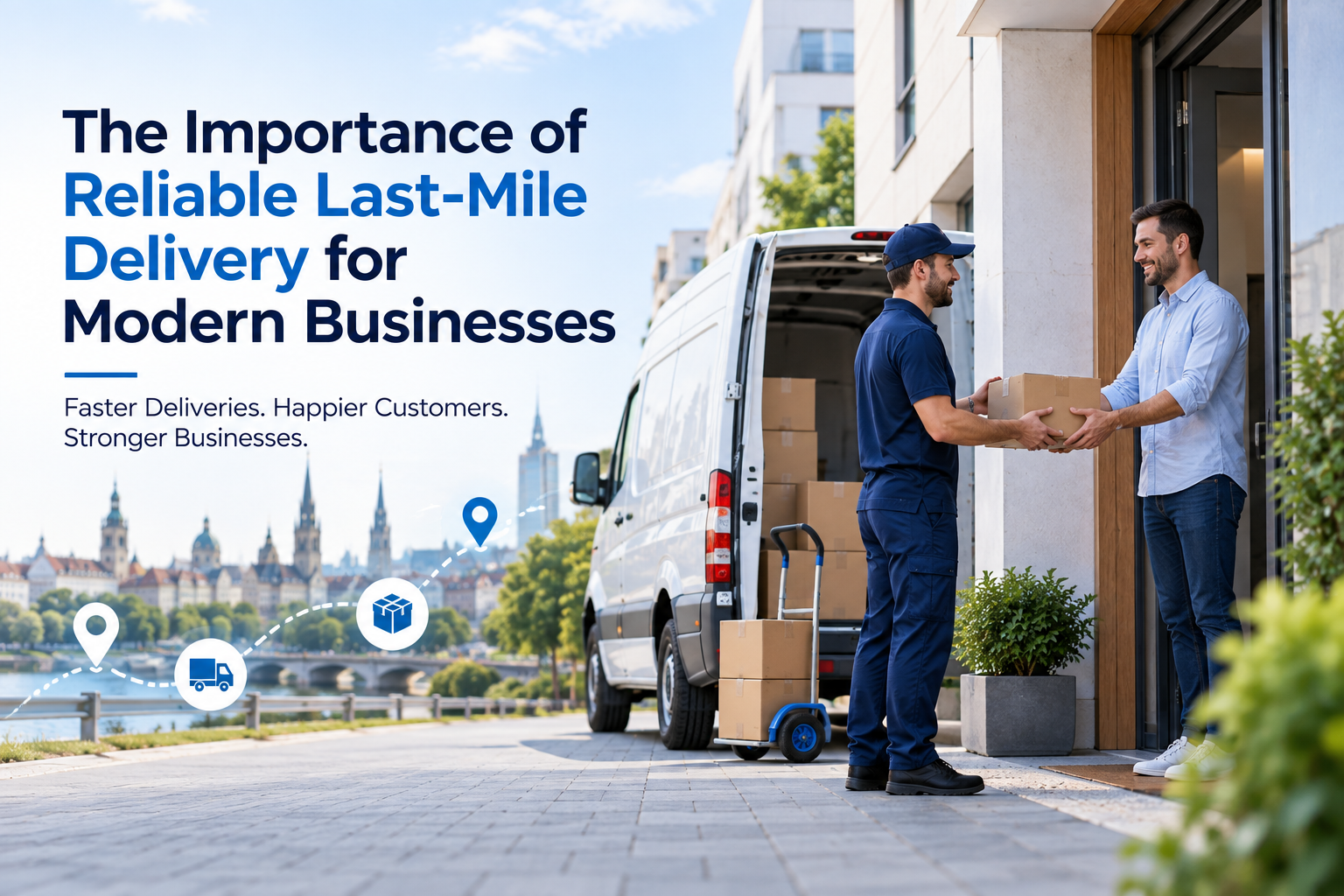
For modern businesses, getting a product to the customer is just as important as producing and selling it.
Customers increasingly expect deliveries to be convenient, predictable and reliable. Whether a business sells directly to consumers or supplies products to other companies, the final stage of transportation can have a major impact on customer satisfaction and overall business performance.
This final stage is known as last-mile delivery.
Last-mile delivery refers to the movement of goods from a distribution centre, warehouse or local transportation hub to the final delivery destination. Although it is the last step in the supply chain, it can be one of the most important.
For businesses operating in competitive markets, a reliable last-mile delivery strategy can help improve customer experience, control logistics costs and create a stronger foundation for growth.
What Is Last-Mile Delivery?
Last-mile delivery is the final stage of the logistics process.
A typical supply chain may look like this:
Supplier → Warehouse → Distribution Centre → Local Hub → Customer
The last-mile stage begins when a shipment leaves a local facility and ends when it reaches its final destination.
This could be:
- A customer’s home
- A retail store
- A business facility
- A construction site
- A distribution location
- Another designated delivery point
While the distance involved may be relatively short, last-mile delivery can be operationally complex because shipments often involve multiple destinations, delivery windows and local traffic conditions.
Why Is Last-Mile Delivery Important?
A product is not truly delivered when it leaves a warehouse.
It is delivered when it reaches the customer.
This makes the final stage of transportation a critical part of the overall customer experience.
A reliable delivery operation can help businesses provide:
- More predictable delivery times
- Better customer communication
- Fewer delivery problems
- Improved operational efficiency
- Greater supply chain visibility
- Stronger customer relationships
For businesses that depend on regular deliveries, last-mile logistics can directly influence how customers perceive the company.
1. Reliable Delivery Improves Customer Satisfaction
Customers expect businesses to keep their delivery promises.
If an order arrives late, damaged or at an inconvenient time, the customer’s perception of the entire business can be affected.
Reliable last-mile delivery helps companies provide a more consistent experience.
When customers know what to expect, they are more likely to trust the business and return for future purchases.
For modern companies, delivery is therefore not simply a transportation function. It is part of the customer experience.
2. Last-Mile Logistics Supports Business Growth
As businesses grow, the number of deliveries they need to manage can increase significantly.
A company may start by serving customers in one local area and eventually expand into additional cities, regions or countries.
This creates greater pressure on the logistics operation.
An effective last-mile delivery strategy allows businesses to handle increasing delivery volumes without compromising service quality.
Scalable logistics processes can help businesses expand while maintaining reliable delivery standards.
3. Efficient Delivery Can Help Control Costs
Last-mile delivery can involve significant operational expenses.
Costs may come from:
- Fuel
- Vehicle operation
- Driver time
- Route planning
- Failed deliveries
- Waiting time
- Additional handling
- Multiple delivery attempts
Poor planning can increase these costs.
Efficient route planning and delivery coordination can help businesses reduce unnecessary travel and make better use of available transportation resources.
The objective is not simply to deliver faster.
It is to deliver efficiently, reliably and cost-effectively.
4. Better Route Planning Improves Efficiency
Every delivery route presents different challenges.
Traffic, road conditions, delivery windows, customer availability and the number of stops can all affect transportation efficiency.
Professional logistics planning can help businesses organise delivery routes based on real operational requirements.
Better route planning can potentially reduce:
- Unnecessary mileage
- Fuel consumption
- Driver downtime
- Delivery delays
- Vehicle utilisation problems
For businesses handling a large number of deliveries, even small improvements can have a meaningful impact over time.
5. Delivery Visibility Builds Customer Trust
Customers increasingly want to know when their orders will arrive.
Shipment tracking and delivery updates can provide greater visibility throughout the final stage of transportation.
For businesses, better visibility also means better control.
If a delay occurs, logistics teams can identify the issue and communicate with customers more effectively.
Instead of customers wondering where their shipment is, businesses can provide clearer information about delivery progress.
6. Reliable Last-Mile Delivery Reduces Failed Deliveries
A failed delivery can create additional costs and inconvenience.
For example, a delivery may fail because:
- The recipient is unavailable
- The address is incorrect
- Access to the location is difficult
- The delivery window is missed
- Communication is unclear
Each failed attempt may require additional time, fuel and resources.
Effective delivery coordination can reduce these problems by improving communication, scheduling and route planning.
This can make the final delivery process more efficient for both businesses and customers.
7. Last-Mile Delivery Can Strengthen Your Brand
A company’s brand is influenced by every interaction a customer has with it.
That includes the delivery experience.
A professional and reliable delivery process can reinforce a company’s reputation for quality and dependability.
On the other hand, repeated delivery problems can create frustration even when the product itself is excellent.
For this reason, businesses should consider logistics as part of their wider brand experience.
8. Reliable Logistics Helps Businesses Manage Growing Demand
Growth can create logistical challenges.
An increase in orders means more shipments, more delivery destinations and greater pressure on transportation resources.
Businesses need logistics processes that can adapt to changing demand.
A flexible last-mile delivery operation can help companies respond to:
- Seasonal demand
- New customers
- Promotional campaigns
- Geographic expansion
- Increased order volumes
- Changing delivery requirements
This flexibility can be particularly valuable for businesses experiencing rapid growth.
9. Last-Mile Delivery Supports Better Supply Chain Management
Last-mile transportation does not operate independently.
It is connected to the wider supply chain.
If a warehouse releases shipments late, the delivery schedule can be affected.
If transportation capacity is limited, customers may experience delays.
If delivery information is inaccurate, businesses may have difficulty planning inventory and customer service.
This means last-mile logistics should be considered as part of the entire supply chain rather than as a separate activity.
Better coordination between warehousing, transportation and delivery teams can create a more efficient overall operation.
10. Technology Is Changing Last-Mile Logistics
Technology is playing an increasingly important role in modern logistics.
Businesses can use digital tools to improve areas such as:
- Route planning
- Shipment tracking
- Delivery scheduling
- Driver communication
- Customer notifications
- Performance monitoring
Data can also help businesses understand delivery performance and identify areas for improvement.
For example, companies can analyse delivery times, failed deliveries, route efficiency and transportation costs.
This allows logistics decisions to become more data-driven rather than relying entirely on manual processes.
What Makes a Last-Mile Delivery Service Reliable?
Reliability involves more than simply delivering a shipment.
A strong last-mile delivery operation should focus on several important factors.
Accurate Delivery Planning
Shipments should be scheduled according to realistic delivery times and available transportation capacity.
Clear Communication
Businesses, logistics providers and customers should have access to relevant delivery information.
Efficient Routes
Transportation routes should be planned to minimise unnecessary travel while maintaining delivery requirements.
Flexible Operations
Delivery networks should be able to respond to changes in demand, destinations and schedules.
Shipment Visibility
Tracking and timely updates can help businesses maintain greater control over deliveries.
Professional Handling
Goods should be transported and delivered with appropriate care to reduce the risk of damage.
How Businesses Can Improve Last-Mile Delivery
Businesses looking to improve their delivery operations can start with several practical steps.
Analyse Current Delivery Performance
Review delivery times, failed deliveries, transportation costs and customer feedback.
Improve Route Planning
Identify opportunities to reduce unnecessary mileage and improve vehicle utilisation.
Use Shipment Tracking
Provide better visibility for both logistics teams and customers.
Improve Customer Communication
Clear delivery notifications can reduce confusion and failed delivery attempts.
Work With an Experienced Logistics Partner
Professional logistics support can give businesses access to transportation expertise, operational resources and scalable delivery solutions.
Why Choose a Professional Logistics Partner?
Managing last-mile delivery internally can become increasingly difficult as delivery volumes grow.
A professional logistics provider can help businesses coordinate transportation and delivery operations while allowing internal teams to focus on their core activities.
The right partner can provide:
- Reliable transportation
- Delivery coordination
- Route planning
- Shipment visibility
- Flexible logistics solutions
- Scalable support
- Professional communication
This can be especially valuable for businesses expanding into new markets or experiencing increased delivery demand.
The Future of Last-Mile Delivery
The last mile will continue to evolve as customer expectations, technology and business models change.
Businesses are likely to place greater emphasis on:
- Delivery visibility
- Route optimisation
- Digital communication
- Operational efficiency
- Flexible delivery options
- Sustainable transportation
Companies that invest in reliable logistics processes will be better positioned to meet changing customer expectations.
The goal is not simply to move products from a warehouse to a destination.
It is to create a delivery experience that supports the entire business.
Reliable Last-Mile Delivery With Immensity Global
For modern businesses, reliable delivery is an essential part of successful logistics.
From route planning and transportation coordination to shipment visibility and final delivery, every stage matters.
A strong last-mile delivery strategy can help businesses improve customer satisfaction, control operational costs and create a logistics network capable of supporting long-term growth.
At Immensity Global, we understand the importance of dependable transportation and logistics solutions for businesses operating in today’s competitive environment.
Our focus is on helping businesses move goods efficiently and reliably while supporting their changing logistics requirements.
Whether you are managing regular deliveries or expanding your operations, having the right logistics strategy can make your supply chain more efficient and your customer experience stronger.
Reliable logistics. Better deliveries. Stronger business growth.
If your business needs dependable transportation and logistics support, contact Immensity Global to discuss your requirements.
Frequently Asked Questions
What is last-mile delivery?
Last-mile delivery is the final stage of the logistics process, where goods are transported from a warehouse, distribution centre or local hub to their final destination.
Why is last-mile delivery important?
Reliable last-mile delivery can improve customer satisfaction, reduce delivery problems, support business growth and improve overall supply chain efficiency.
How can businesses reduce last-mile delivery costs?
Businesses can improve route planning, reduce failed deliveries, optimise vehicle utilisation and use technology to improve transportation coordination.
How does technology improve last-mile delivery?
Technology can provide better route planning, shipment tracking, delivery scheduling, communication and performance analysis.
Can small businesses benefit from professional last-mile logistics?
Yes. Professional logistics services can help small and growing businesses access transportation expertise and delivery capabilities without building a complete logistics operation internally.
What should businesses look for in a last-mile delivery partner?
Businesses should consider reliability, communication, transportation capabilities, flexibility, shipment visibility, geographic coverage and the ability to scale with future demand.
Final Thoughts
Last-mile delivery may be the final step in the supply chain, but its impact can reach far beyond the delivery itself.
A reliable final-mile operation can strengthen customer relationships, improve logistics efficiency and give businesses the flexibility they need to grow.
For modern businesses, reliable last-mile delivery is not just a logistics requirement — it is a competitive advantage.