
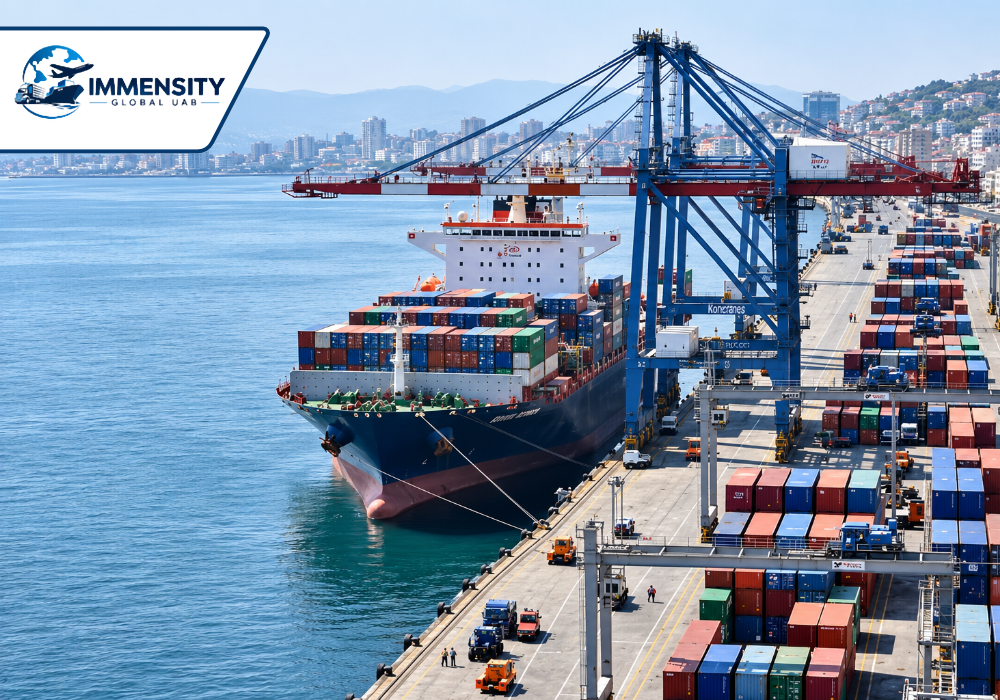
Global sea freight services help businesses transport commercial goods between international markets using cargo vessels and established shipping routes. They support large, heavy, and consolidated shipments through container-based transportation. According to the European Commission, approximately 13 billion tonnes of traded goods moved by sea worldwide in 2024, highlighting maritime transport’s role in global trade.
What Are Global Sea Freight Services?
Global sea freight services involve coordinating the transportation of goods between countries through ocean-going vessels. They connect manufacturers, suppliers, exporters, importers, ports, and distribution networks.
Businesses use ocean transportation to move products in different quantities and cargo categories. These include industrial machinery, furniture, construction materials, automotive components, packaged goods, textiles, and raw materials.
Unlike air transportation, sea shipping can accommodate large cargo volumes and heavy equipment. It is often a practical choice when businesses have flexible delivery schedules and want to manage transportation costs.
A typical shipment involves several activities:
-
Cargo collection and shipment preparation.
-
Container selection and booking.
-
Export documentation and customs coordination.
-
Port handling and vessel loading.
-
International ocean transportation.
-
Import customs clearance.
-
Final delivery to the receiving location.
These activities require coordination between different service providers. Therefore, businesses often work with freight forwarding specialists to organize their shipments.
Why Do Businesses Choose Sea Freight for International Shipping?
Sea freight offers businesses substantial cargo capacity, flexible shipping arrangements, and access to international markets. It is particularly useful for companies that regularly transport large quantities of commercial goods.
Here are some important reasons businesses select sea transportation.
1. Suitable for large cargo volumes
Ships can carry substantial quantities of commercial products in containers and other cargo arrangements. This makes ocean transportation suitable for manufacturers, wholesalers, retailers, and industrial suppliers.
2. Practical transportation costs
Sea transportation can offer lower freight costs per unit for larger shipments compared with air transportation. However, the final cost depends on cargo dimensions, route, handling requirements, and additional charges.
3. International market connections
Ocean shipping connects major commercial ports across different continents. Businesses can use these connections to manage imports, exports, and international supply chains.
4. Flexible cargo arrangements
Companies can select full-container or shared-container shipping according to their cargo volume. Specialised equipment may also be required for certain goods.
5. Support for regular shipments
Businesses with recurring transportation requirements can plan shipping schedules and coordinate cargo movements according to inventory and production needs.
What Are the Main Types of Sea Freight Shipping Services?
Sea freight shipping services generally include Full Container Load (FCL), Less Than Container Load (LCL), and specialised cargo arrangements. The right option depends on shipment size, cargo characteristics, handling requirements, and delivery schedules.
Full Container Load (FCL)
FCL shipping means one shipper books an entire container for their cargo. The shipper does not need to fill every available space, but the container is allocated to that shipment.
This option is useful for businesses transporting large quantities of goods. It can also simplify cargo handling because the shipment does not need to share container space with unrelated consignments.
Less Than Container Load (LCL)
LCL shipping allows multiple businesses to share container space. Each shipper pays for the portion occupied by their cargo rather than booking an entire container.
This arrangement can suit smaller shipments that do not require a full container. However, consolidation and deconsolidation can add handling stages and affect transit schedules.
Specialised Container Shipping
Some products require equipment beyond standard dry containers. Examples include refrigerated containers for temperature-sensitive cargo and open-top or flat-rack containers for certain oversized goods.
Businesses should confirm cargo dimensions, weight, handling requirements, and equipment availability before booking.
FCL vs LCL: Which Shipping Option Should You Choose?
The following comparison explains the main differences between these two shipping arrangements.
| Comparison factor | FCL shipping | LCL shipping |
|---|---|---|
| Container use | Entire container allocated to one shipment | Container space shared |
| Best suited for | Larger cargo volumes | Smaller consignments |
| Pricing basis | Container booking | Cargo volume or chargeable measurement |
| Cargo handling | Generally fewer consolidation stages | Consolidation and separation required |
| Scheduling | Depends on vessel and container availability | Also depends on consolidation schedules |
| Main consideration | Total container cost | Handling charges and shared space |
Neither option is automatically better for every shipment. Businesses should compare the total landed transportation cost rather than focusing only on the initial freight quote.
How Do Ocean Freight Forwarding Services Work?
Ocean freight forwarding services coordinate the different stages involved in moving goods from the shipping origin to the final destination. A freight forwarder works with carriers, ports, customs representatives, and transportation partners.
The process generally follows these steps.
Step 1: Shipment assessment
The process begins with information about the cargo. Businesses provide the product description, dimensions, weight, quantity, pickup location, destination, and preferred delivery schedule.
This information helps identify suitable transportation arrangements.
Step 2: Route and carrier planning
The forwarding team reviews available shipping routes and carrier options. Port locations, vessel schedules, cargo requirements, and estimated transit times help determine a suitable plan.
Step 3: Booking and cargo preparation
After selecting the shipping arrangement, the shipment is booked with the relevant carrier or service provider. The cargo is then prepared for collection, packing, and container loading.
Step 4: Documentation and export clearance
International shipments require accurate commercial and transportation documents. Export customs procedures must also be completed according to applicable regulations.
Step 5: Ocean transportation
Once the cargo clears the required export procedures, it moves through the port and is loaded onto the assigned vessel. The shipment then travels towards its destination port.
Step 6: Import clearance and final delivery
At the destination, the cargo undergoes the required import customs procedures. After clearance and release, transportation partners can arrange collection and onward delivery.
A well-coordinated process helps businesses understand shipment responsibilities and manage potential delays.
Which Documents Are Required for International Sea Freight?
International sea shipments require accurate documentation to support transportation, customs clearance, and cargo identification. Requirements vary according to the goods, origin, destination, and applicable trade regulations.
Common shipping documents include:
-
Commercial Invoice: Describes the goods, their declared value, seller, and buyer.
-
Packing List: Provides package quantities, weights, dimensions, and cargo details.
-
Bill of Lading: Acts as a transport document and provides evidence of the contract of carriage. Its legal functions depend on the document type.
-
Certificate of Origin: Identifies where the goods originate when required.
-
Export Declaration: Provides shipment information to the relevant export customs authority.
-
Import Documentation: Supports destination customs procedures and regulatory checks.
Some shipments may require additional certificates, permits, inspection records, or product-specific documentation.
Businesses should check the requirements before cargo departure. Incorrect descriptions, missing information, or inconsistent documents can cause customs queries and additional handling costs.
What Factors Affect Global Sea Freight Costs?
Global sea freight costs depend on cargo specifications, shipping routes, carrier availability, port charges, and additional transportation requirements. Therefore, businesses should evaluate the complete shipment cost before confirming a booking.
Important cost factors include:
Cargo size and weight: Container dimensions, cargo volume, weight, and special handling requirements influence pricing.
FCL or LCL selection: Full-container and shared-container arrangements have different pricing structures.
Shipping route: Origin and destination ports, transshipment requirements, and sailing distances affect freight rates.
Seasonal demand: Shipping demand can change during peak trading periods. Available vessel space and market conditions may influence prices.
Port and terminal charges: Handling, documentation, storage, and terminal-related charges can contribute to the final cost.
Customs and inland transportation: Duties, taxes, clearance services, trucking, and final delivery may be additional expenses.
To compare quotations accurately, businesses should request a breakdown of included services, excluded charges, and any applicable surcharges.
How Can Businesses Choose the Right Sea Freight Forwarding Companies?
Choosing among sea freight forwarding companies requires evaluating their shipping knowledge, communication, service coverage, documentation support, and ability to coordinate different transportation stages.
Consider these factors before selecting a provider.
International shipping experience: Look for a provider familiar with your cargo type, trade routes, and destination requirements.
Carrier and partner network: Ask how the provider arranges vessel bookings and coordinates port-related activities.
Documentation knowledge: Confirm that the forwarding team understands the documents and customs procedures relevant to your shipment.
Shipment visibility: Regular tracking updates help businesses plan inventory and communicate with customers.
Transparent quotations: Request clear information about freight charges, additional fees, and service responsibilities.
End-to-end coordination: Consider whether the provider can coordinate port transportation and inland delivery through suitable partners.
A transportation company in Europe should also understand regional distribution requirements and cross-border transportation arrangements.
For companies operating across multiple markets, working with global logistics companies can help coordinate different transportation activities under a more organised shipping plan.
How Does Sea Freight Connect with Other Global Logistics Services?
Sea freight works best as part of a wider transportation plan that connects ports, warehouses, distribution centres, and final delivery locations. Businesses may require additional services before or after the ocean journey.
For example, road transportation can move containers between ports and warehouses. Warehousing can support temporary storage, inventory management, and distribution planning.
Air transportation may be suitable when urgent goods cannot wait for ocean transit. Therefore, businesses should select transportation methods according to shipment priorities.
A logistics company in Europe can help coordinate different transport modes according to cargo requirements and delivery destinations.
At Immensity Global, the service offering includes sea freight, air freight, road freight, warehousing, forklift services, and drayage. These services can support different stages of commercial cargo movement.
Businesses can learn more about the available global logistics services and explore the company’s international air freight services for time-sensitive shipments.
What Should Businesses Consider Before Booking a Sea Shipment?
Before booking, businesses should confirm that their cargo details, shipping documents, delivery expectations, and destination requirements are accurate.
Use this practical checklist:
-
Confirm the pickup and delivery addresses.
-
Check the cargo description and applicable restrictions.
-
Measure the cargo and verify its gross weight.
-
Decide whether FCL or LCL is more suitable.
-
Confirm the required container type.
-
Review the estimated vessel schedule and transit time.
-
Check export and import documentation requirements.
-
Clarify customs responsibilities and additional charges.
-
Discuss cargo insurance and suitable protection options.
-
Confirm the final delivery arrangement.
Advance planning gives businesses more time to address documentation issues, coordinate transportation partners, and prepare receiving facilities.
It is also important to remember that estimated transit times are not guaranteed. Port congestion, weather, customs inspections, vessel schedule changes, and other operational conditions can affect delivery.
Frequently Asked Questions
1. What are global sea freight services?
Global sea freight services involve transporting commercial goods between international ports using cargo vessels. They include container booking, cargo coordination, shipping documentation, port handling, and delivery arrangements. Businesses commonly use these services for large, heavy, or non-urgent shipments moving across international markets.
2. How long does international sea freight shipping take?
International sea freight transit times depend on the origin, destination, shipping route, vessel schedule, and port conditions. Some routes take a few weeks, while longer journeys can take more time. Customs procedures, transshipment, and inland delivery can also affect the overall shipment timeline.
3. Is FCL better than LCL shipping?
FCL can be suitable when a business has enough cargo to justify booking an entire container. LCL is often useful for smaller shipments that can share container space. Businesses should compare total freight costs, handling charges, shipment schedules, and cargo requirements before selecting an option.
4. What does an ocean freight forwarder do?
An ocean freight forwarder coordinates cargo transportation between the shipper and destination. Responsibilities can include carrier booking, route planning, documentation support, customs coordination, shipment updates, and delivery arrangements. The exact responsibilities depend on the agreed service scope and the parties involved.
5. How can I get a global sea freight shipping quote?
To request a shipping quote, provide your cargo description, dimensions, gross weight, quantity, pickup location, destination port, and preferred delivery schedule. Also mention whether you need FCL or LCL transportation. A forwarding specialist can review these details and discuss suitable shipping arrangements and estimated costs.
Conclusion: Are Global Sea Freight Services Right for Your Business?
Global sea freight services provide businesses with a practical way to transport commercial cargo across international markets. With suitable container selection, accurate documentation, route planning, and transportation coordination, companies can manage large shipments and support their international supply chains.
However, selecting the right forwarding partner is just as important as choosing a shipping method. Businesses should consider cargo requirements, delivery schedules, transportation costs, and customs responsibilities before booking.
Immensity Global supports businesses with international freight coordination and transportation solutions across Europe and beyond.
Need support with your next international shipment? Contact Immensity Global to discuss your cargo requirements and request a suitable sea freight solution.